

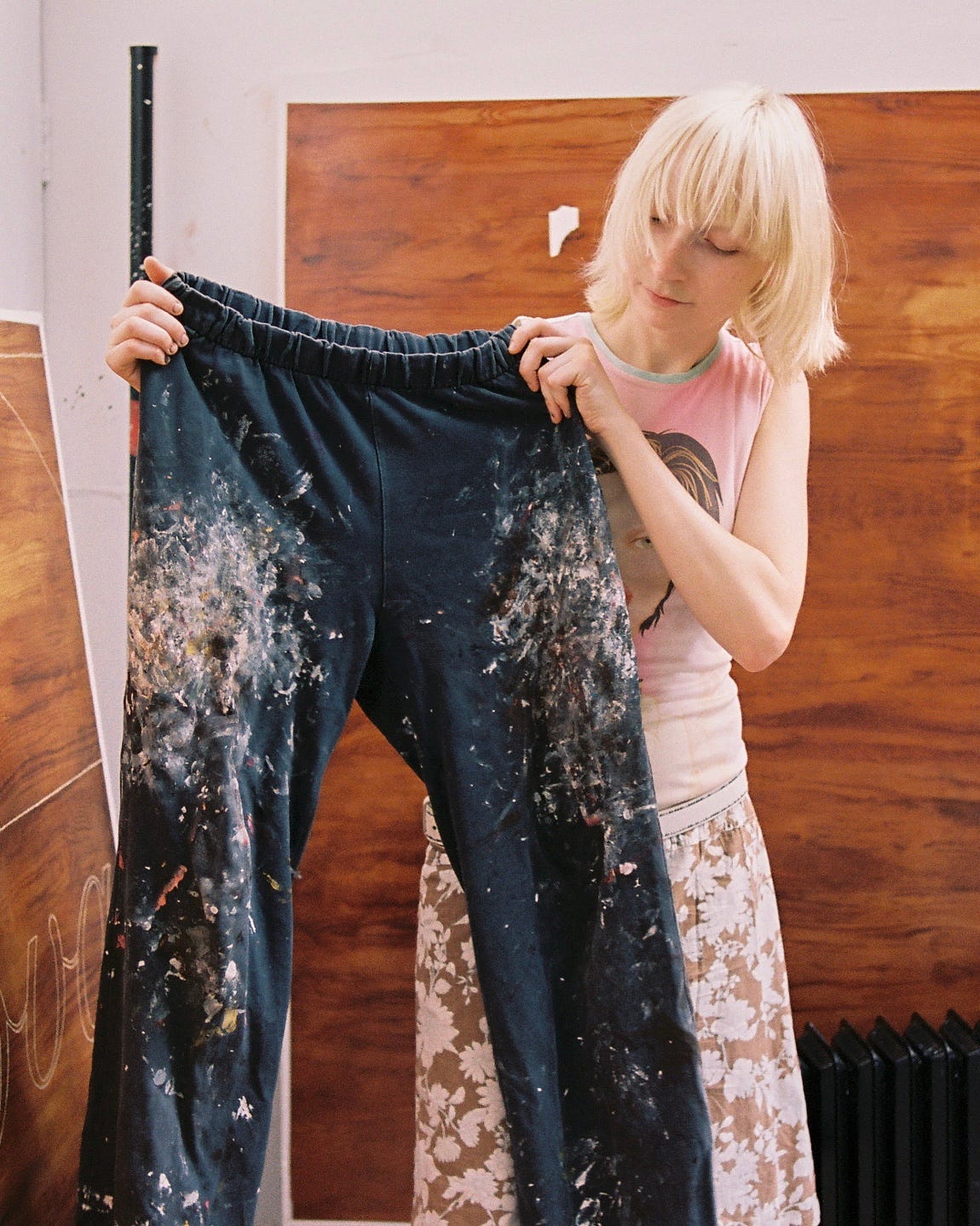
On the day of my exhibition opening at NICOLETTI, I was already on a bus at 4:43am. I’ve been trying to emulate the billionaire lifestyle, which apparently involves waking up at an hour when most people are still deep in REM sleep. I went to the gallery to sort out a few things, including some video elements that needed adjusting, before sourcing materials for a painting I’m showing at Frieze London. The process was surprisingly straightforward: I essentially showed someone at Leyland a picture of a Cartier Love Bracelet and asked if they had something similar, but for a pipe. It totally worked.
Waking up at 4am is a relatively new experiment. At the beginning of September, I decided that, for my last two weeks in London, I would wake up at 4am every day. My friend and studio neighbour swears by it, insisting it’s how they get everything done. I thought I’d give it a go. I remain unconvinced. Because I’m moving countries, everything I own is either packed in a box or dirty, so getting dressed was a logistical exercise in finding something clean enough but that also lasts from 4am until 11pm.


For the opening, I went for my Oxford scarf and a vaguely librarian-coded outfit. I’ve also returned to my natural hair colour after being bleach blonde, feeling more whispers in the library these days. So, I wore a cute Brandy Melville blouse and Joop dress and some random shoes I bought in Zurich when I was there for Deborah Levy’s play 50 Minutes at the now-closed Jelmoli, Switzerland’s answer to Selfridges.
The gallery had organised a little pre-opening lunch, which was very cute. I have no idea what was on the menu. Everything was arranged by the gallery, and I barely had time to eat. People served themselves, so it was quite casual. I gave everyone a tour of the exhibition, which turned out to be more exhaustive than I’d anticipated. Talking about your own work while everyone is looking directly at you is a particular kind of performance.
The exhibition will keep rotating, with all my existing series of works entering into conversation with one another in two-week slots. The idea is that the show is never entirely the same, which also means you’ll inevitably miss something. I like the idea that an exhibition can exist as a series of pictures rather than a fixed, complete experience, like a puzzle to understand it all but also not really.
After the tours, I got myself a pizza and sat alone for a bit. My phone had died, although I’m not sure whether I can blame the 4am start for that. I needed a moment away from everyone before the actual opening began.
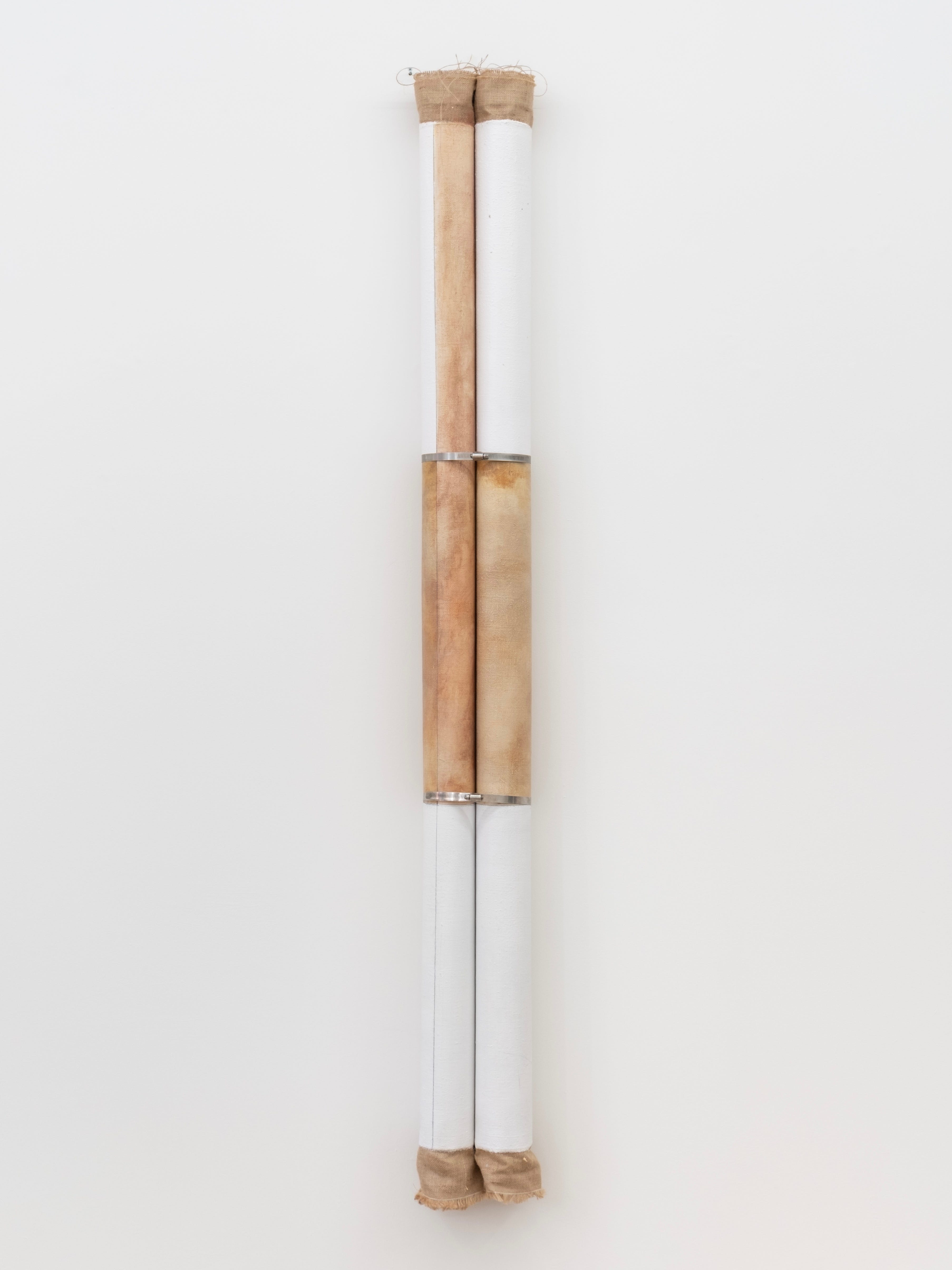
The opening also doubled as my leaving drinks. I’m leaving London for Frankfurt or, more accurately, a small town nearby, where I’ve got a space that I’m developing into a new cultural centre, library and exhibition space. That project is becoming a major focus for me, alongside the upcoming solo booth at Frieze, Art Basel Paris and several museum projects coming in early 2027. There’s something quite strange about opening an exhibition at the same time as packing up the life that produced it.
By 5pm, people had started arriving for the opening proper. I did a few more tours, and it was genuinely lovely to see so many of my friends in one place. Everyone seemed to be there. The evening was a bit of a blur, but my truly amazing friends Emma Alvin, Arthur Satchurski, Olivia Allen and Tosia Leniarska were there. My bestie Vincenzo Ottino joined via FaceTime, alongside Dean Kissick, Caroline Polachek, Matt Copson and Roisin Tapponi, whose new book Scene City, published by Verso, features one of my paintings on its cover.
A lot of people recognised themselves in Liora, the video included in the exhibition’s first rotation. It functions as a kind of time document of London’s art and social scene, but also as a record of my 2025, featuring many of my friends, including Lydia Eliza Trail, Karo Franka, Leonie Miller Aicholz, Hunter Boyd, Benedict Winkler, Gulliver Whitby and Antoin Sharkey.
One of my favourite moments in the film is when Dilara [Findikoglu] advises the models to “be themselves, but as an actor.” I love that contradiction. It feels like a very contemporary condition: the self as something you inhabit, but also something you perform. It reminds me of Ciao! Manhattan (1972), which introduces Edie Sedgwick as playing herself in the role of Susan. There’s something revealing about the gap between being yourself and playing yourself, particularly when the medium is a camera.


One of the nicest things someone said about the exhibition was that it felt like my brain. I think that’s probably the best compliment you can receive as an artist. They could see me in every work, and the whole thing felt very me. There was also a rumour that Dean Kissick had said it was the only truly real artwork ever to be shot on an iPhone, he finally understood Gen Z life, and people were crying. I can’t independently verify Dean’s statement, but I’m happy to preserve the rumour, the crying is true.
After the opening, there were joint drinks with Emalin at the William IV pub, celebrating Sung Tieu’s exhibition How Is Your Day?, which I thought was genius. By that point, I was completely exhausted. I made it home at around 11pm.
I left my own party early, having finally accepted that the billionaire-hustler lifestyle might not be for me. The following day, I woke up after twenty hours of sleep. So much for waking up at 4am.
Learn more about Ana’s solo exhibition, “Fundus: A Schizo Society’s Longing for the Armchair Psychology of Visual Cohesion (An Examination)” here.